Venture
Where are you when you're homeless? Certainly you're somewhere. Are you trespassing? Are you just in limbo? How long do you go without a home before you're homeless? And then what part of society and what rights do you lose? Does having a home affect your humanity or intelligence or usefulness? If a home is an answer, is homeless a question? Or a mistake? Can a home safeguard you against depression or death or isolation? Certainly homes burn down and blow away and leak. Is a home a physical or an emotional need? Though I've been without a home, I've never been homeless. Why is that?
Assumptions
When I told my peers I was going to live at Tent City, I was surprised by how many asked if I was doing it out of necessity or as a project. Hmmm, I thought, people must see me as unstable. But perhaps unconventional is more true. I've been told to keep in mind that when I'm done I'll be going home, while those I'm serving won't be. What does this assume? That I have a home. I have no home. What does it mean to say I have no home. I don't know if I can even explain, but I know that while I am not homeless in the way that some people are, I also have no home. I have a 24' sailboat and rent a small office in Fremont. I am a successful artist who lives from job to job. I have no health insurance. My student loans are in deferment. What else does it assume? It assumes that some of us aren't going home. If those people are not going home, where are they going?
Waypoints
Tent City is not an
endpoint. It is a
waypoint. But what if there's nowhere else to go? That's when people get stuck. The waypoint becomes a default endpoint. If you can't get a job, you'll eventually be homeless. If you're homeless, it's unlikely anyone will hire you. If you don't have a job, you can't get housing. If you can't get housing, you're no one. Nowhere. The responses of my peers got me thinking about who I am and where I belong and where any of us belong. Housing in the U.S. is not a right. It is a privilege. Is
this the problem? I worry about the scrambling I see around me--to fit in, to be seen, to be heard, to be safe, to be free of blame. I see it in everyone, in the poor and in the rich, in the artist and in the entrepreneur. We're all scrambling. Why? Is it fear? Fear of what? Being homeless? Being nobody? If we look at it from another angle, perhaps we can see how it is really about being loved and about belonging. And if it is about being loved about belonging, we can surely, in a country so rich with land and resources, create a place for everyone, with houses and roofs and jobs for all. Then, when there is less scrambling, there will be energy for organizing.
Dwellings
I was looking into DIY and low-cost shelters when I came across the
Irregular Shelter site with 67 options for irregularly shaped, alternative living units, including
Homeless Chateau and the
Edar (Everyone Deserves a Roof). Irregular Shelter led me to N55 and the manual for
Micro Dwellings, a system for constructing low cost dwellings. N55 is offering alternatives like the walking, watertight dwelling pictured above. Unlike many sites and sources on homelessness, they discuss not only the problem, but the causes--the non-availability of affordable housing. "Current building techniques in the western world have failed to incorporate knowledge of geometry that enables lightweight and durable constructions which can be produced at a fraction of the cost of conventional houses. The lack of innovation in this field can be ascribed to the enormous economic interests that are tied to real estate. Challenging habitual conceptions in this area is seen as a risk not worth undertaking. However, the present situation creates considerable inequalities, where people with even average incomes can't afford to buy or rent in major cities or suburbia. As a result, monoculture prevails and people with lower incomes are forced into the margins or into finding alternative solutions. Making dwellings available for less money would reduce the need for high incomes. This in turn could free time for activities other than money-generating work, something that could have a positive social impact" (N55).
Not only must we find a long-term solution to homelessness, we must identify and promote better temporary solutions. Currently, hundreds of people are living in flimsy tents in the freezing, rainy season as well as the beautiful dry season in Seattle. Standard camping tents last little more than a year when subjected daily to the elements and then must be covered with tarps and repaired with duct tape. I'm not a historian or a politician. I'm a poet going to do a poetry project at Tent City. Like you, I care about issues and worry about affordable housing and healthcare and education. As we work towards these goals, I wonder, whose voice can we afford to lose--the weak, the poor, the aged, the sickly, the artist? When one day we lose our voice--for all of us will age and get sick and grow weak--who will speak for us then? Who should speak, and when?
Hard-A-Lee
I drove across town, through Lake City, south on 35th past
Nathan Hale High School and up Ravenna to
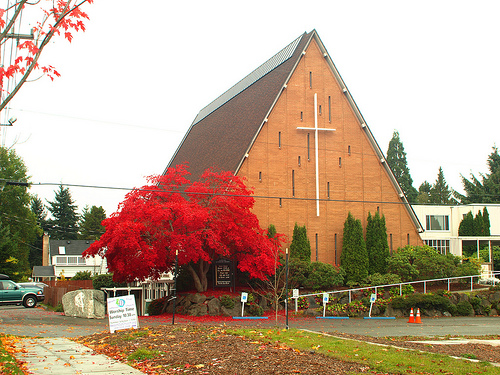
Maple Leaf Lutheran Church, a bulky, brown A-frame on the corner of NE 100th & 32nd NE. As I approached, I realized--Hey, I know this neighborhood. My good friend Frank lives here. The
Fiddler's Inn is around the corner. My life in Seattle started here. When I arrived, in '99, I stayed with a friend just off Lake City Way. I stayed on his couch (which means I was homeless) while looking for an apartment. I'd come for the love of the mountains. I'd climbed Rainier and was smitten. I quit my publishing job and left Boston for the wilds of Washington. In the first seven days, I took a job as a baker in Wedgewood. Every morning, I rode my bike across Lake City Way and up 35th in the dark, cold, wet, October predawn, leaves painting the roadways. Two months later, I had a shared apartment in West Seattle and took another job. Then I landed a steady job at a publishing house and moved again. Then I became a project manager at the UW. It wasn't until 2001 that I moved into the little studio apartment I called home. I stayed there for two years and then was sailing and able to buy a little sailboat and another dream spread itself before me--to sail around the world--which I did go and crew on a boat out of CA across the Pacific to Polynesia where I lived in a lagoon for three months. Home. Where is home? Here it is, in a parking lot in Meadowbrook. With a red brick neighbor with a cross to bear and others who don't want me here: "No Tent City."
Neighborhood Notification Meeting
There was a "Neighborhood Notification Meeting Regarding Temporary Encampment" at
Maple Leaf Lutheran Church on Sunday 14 November. This meeting was intended to "provide an opportunity for the public to learn more about SHARE/WHEEL's Tent City3." I found out about it by chance, just the day before, when paging through the church's website (the host site typically has a tab dedicated to info about Tent City). I went to the meeting to show my support and get a sense of the camp-to-public interface. I also wanted to meet the outreach coordinator for the church whom I'd spoken to on the phone. I still have so many questions. I don't know what the relationship is between the church and the camp or how SHARE/WHEEL communicates with them. I don't know if any indoor places have been identified for holding classes or meetings or perhaps that's just not done. What is an acceptable noise level? Can residents play music in camp? What is discussed at the weekly meetings? Is there an inter-camp mail system? I wonder Are there any existing programs that meet daily or weekly? Do people stay in the camp during the day or does camp empty out in the morning? How are meals organized? How strict is the footprint of Tent City? Where will my desk go? How about my tent? Most of these questions will, no doubt, be quickly answered when I begin to live there.
Exposed
There was a sign on the main door directing neighbors to the basement of the church. The basement was configured with ten rows of folding chairs, a speaker's podium, a row of banquet tables with a microphone and several staffed information tables around the room. I saw Roger straight away. Hello hello! Roger has been my main contact for TC3. He's a woodsman-like character with wire-frame glasses, a sock hat and plaid jacket. He reminds me of Pierre (Count Pyotr Kirillovich), the protagonist in War & Peace, capable of great joy, but reserved, holding on to something, sparkling beneath the surface.
I wandered about the room meeting residents, neighbors, church representatives and SHARE/WHEEL advocates. I learned there would be no contact between the 30 homeless staying overnight in the church (who are sent by bus and must arrive together and are offered mats on the floor from 9pm to 7am) and the 100 homeless men and women living in Tent City3 (who must sign in once a day to maintain their residency and who live in tents and leave their belongings and attend meetings and fulfill camp duties), even though they are sponsored by the same organization, SHARE/WHEEL. I learned about a plan that is underway to provide a warm, dry place for four hours to the residents of Tent City on Christmas Day and about a plan for making Valentines in February.
The meeting was called to session at 7pm. There were roughly forty, middle-aged, Caucasian adult men and women in attendance. Pastor Julie Blum of Maple Leaf Lutheran Church welcomed everyone. Pastor Steve Grumm of Our Redeemer's Lutheran Church in Loyal Heights, a past host of TC3, managed the meeting from there on out. One of his first statements was, "We will all be civil." A flag went up for me. After a short presentation by the residents of Tent City3, the floor was opened to questions. Those who wished to pose a question or make a statement had to sign up. Each person was given two minutes.
Civil
Some came forward with an interest in helping. Some offered praise or recommendations for Tent City. Some talked about the wealth of opportunities Tent City offered them. One said her son learned to play chess at Tent City. Another related a comment by the Seattle Police Department, who called Tent City's visit to their neighborhood a "non-incident." One related an incident, the only one in two years, for which the police were called. Two neighborhood teens were found to be the cause of the disturbance. The most thoughtful question came from a man, a new neighbor, who said he had children and wanted to know what happened to the homeless person who came to Tent City and was rejected because they didn't meet the criteria or wouldn't follow the rules. Do they end up in the bushes nearby? A spokesperson for Tent City explained that those people were escorted to the bus. The escort waited until that person got on the bus. After-hours, they would be put in a cab and the driver given a script. But to which neighborhood they went or from which neighborhood they had come, no one knew. Some were fearful. There was a cluster of fear in a row behind me. Each took a turn at the microphone. None had signed up to speak, but spoke when the floor was opened. Each voiced a concern, not for themselves, but for their children. One asked why the church had "ambushed" them. Another reprimanded a homeless man on the panel for slouching. What these three had in common was the ability to speak, but not listen. Each had to be asked to stop and wait for the response they'd requested. One man was so agitated he left the room. There were audible grumbles from the crowd as he left. By the time the meeting was over, the invisible fence around an invisible Tent City was electric. I felt sick and anxious and emotional. I was impressed by the calm of the residents, by their grace and patience. I congratulated them all afterwards. And they said, "It gets worse." There are roots of fear and faith, I suppose, in the unknown, in the system, in the other, in the wall. And so where do I stand? I have a lot to learn. I want to be strong and brave and graceful like the men and women of Tent City. I want to be able to stand up for what is right, to combat ignorance and fear with love and understanding.
Code of Conduct
Unlike the rest of us, when Tent City moves into a new neighborhood, they must sit before their neighbors and prove they are good people--responsible, quiet, clean, courteous, trustworthy, nonviolent, noncriminal and sober. Despite the fact that Seattle's Tent City is noted as a success story by the
National Law Service on Homelessness and Poverty, they must constantly work to prove and improve their reputation. Those wishing to reside in Tent City must go through a screening process. Residents must show an ID, be drug and alcohol free and commit to participating in camp maintenance. They must sign and follow a strict
Code of Conduct. Tent City does not tolerate drugs, alcohol or weapons. Neither does it tolerate verbal or physical abuse. Sex offenders are not allowed in Tent City. Those in violation of the code of conduct must leave the community. Two security workers from the community are on duty at all times and check in with all visitors. Quiet hours are observed from 10 p.m. to 8 a.m.
Weather
As I write this, the rain is lashing against the window pane. It is suddenly cold. Winter has found us. The rain is coming down in sheets. It makes me fearful. It makes me worried. It makes me think of the people I don't yet know in tents tonight. Soon it will be me. It makes me think of the people who aren't in tents, those waiting out the storm. For now, I'm relishing the heat in my office.
Related News
City Inside/Out
with C.R. Douglas
A Permanent Home for Nickelsville?
Premiered Friday, Nov. 19, 7 p.m.
After months of negotiation, Mayor Mike McGinn has proposed a more permanent site for the roving homeless tent city of Nickelsville. The mayor wants to set up Nickelsville on a vacant lot in SODO--the industrial area south of downtown. The new site would include tent housing, showers and social services. This is a big change in city policy that up until now has frowned on hosting encampments on public land. Is the new mayor being compassionate or misguided? To hash out the issue, we bring into our studio Seattle Deputy Mayor Darryl Smith, Real Change's Tim Harris and The Seattle Times' Bruce Ramsey.